YOUR QUESTIONS
FAQ's
Africa is not one destination.
Tailor-made is the easiest thing to claim and the hardest thing to do. Plenty of companies will move a night from one camp to another and call it bespoke. We start with a blank page.
Before we suggest a single lodge, we want to know how you travel. Whether you’d rather walk than drive. Whether a five-hour transfer is an adventure or an ordeal. Whether the children need a pool. Whether you want to be the only vehicle at the sighting, or you don’t mind sharing if it means an extra night on the water.
Then we build around the answers — season by season, camp by camp, flight by flight — because the Okavango in June is a different country to the Okavango in November, and the itinerary should know that. We offer comprehensive travel adventures to the countries listed below.
The guiding is the best on the continent. That isn’t a marketing line — it’s a training standard.
- Victoria Falls is roughly 1,708 m wide with a maximum drop of 108 m — the largest single sheet of falling water on earth. UNESCO-listed since 1989.
- Mana Pools is one of very few African parks where you may explore on foot without a vehicle — UNESCO World Heritage since 1984, and the spiritual home of the walking safari.
- Hwange covers around 14,650 km² and holds one of Africa’s great elephant populations, widely estimated at 45,000+.
- Zimbabwe’s professional guide qualification takes years to complete and has one of the lowest pass rates in the industry.
Low volume, high value — written into national policy, not just the brochure.
- The Okavango Delta became UNESCO’s 1,000th World Heritage Site in 2014. Its floodwaters travel some 1,200 km from the Angolan highlands and arrive months after the rain that made them.
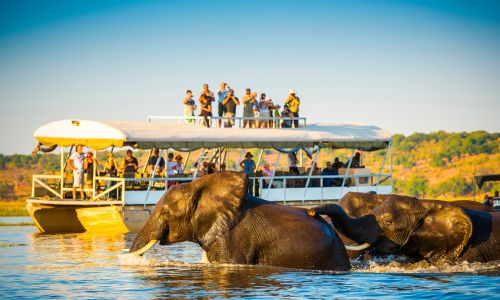
- Botswana holds around 130,000 elephants — the largest population of any country on earth.
- Close to 40% of the country is under some form of conservation management.
- Chobe riverfront in the dry season produces elephant co
Where the walking safari was invented, and where it’s still done best.
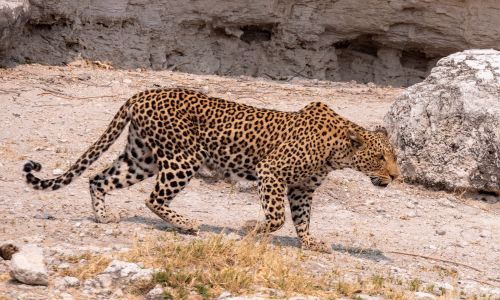
- South Luangwa — roughly 9,050 km² — is credited as the birthplace of the modern walking safari, pioneered by Norman Carr in the 1950s and 60s, and carries one of Africa’s highest leopard densities.
- Kafue covers around 22,400 km², making it one of the largest national parks on the continent.
- The Lower Zambezi offers canoeing, catch-and-release tigerfishing and game drives on the same day.
- Around 30% of Zambia’s land area sits within national parks and game management areas.
Space. Silence. And a conservation model the rest of the world studies.
- Namibia was the first country in the world to write environmental protection into its constitution (1990).
- More than 40% of the country is under conservation management, including 80-plus community-run communal conservancies.
- The Namib is generally regarded as the world’s oldest desert, at somewhere around 55 million years. The dunes at Sossusvlei rise to roughly 325 m.
- It’s the second least densely populated country on earth — around three people per square kilometre.
The easiest first Africa. And a country you can return to for twenty years without repeating yourself.
- Kruger National Park covers about 19,485 km² — roughly the size of Wales.
- The Cape Floral Kingdom is the smallest of the world’s six floral kingdoms and the richest, with around 9,000 plant species, some 70% found nowhere else on earth.
- Ten UNESCO World Heritage Sites, malaria-free Big Five options in the Eastern Cape and Madikwe, and a wine region that can hold its own anywhere.
- World-class road, air and medical infrastructure — which makes it the ideal opening or closing leg for a multi-country route.
The beach half of the trip, done properly.
- Around 2,700 km of Indian Ocean coastline.
- The Bazaruto Archipelago protects the last viable dugong population in the Western Indian Ocean.
- Gorongosa is one of the great conservation recovery stories of our lifetime — wildlife populations rebuilt from near-total collapse to well over 100,000 large animals.
- Two hours’ flying from Kruger or Vic Falls. Bush to beach without a long-haul in the middle.
Underrated, uncrowded, and now a genuine Big Five destination.
- Lake Malawi runs some 700 km and contains more fish species than any other lake on earth — well over 1,000 cichlid species, most endemic.
- Majete went from effectively empty in 2003 to a Big Five reserve by 2012 under African Parks management.
- Liwonde and Nkhotakota received hundreds of translocated elephants in one of the largest wildlife relocations ever attempted.
- Excellent value, and a warmth of welcome that earned the country its nickname honestly.
The great apes — and the clearest example anywhere that tourism revenue saves species.
- Mountain gorilla numbers have climbed from a few hundred in the 1980s to over 1,000 today — the only great ape whose population is increasing, and the reason the species was downlisted from Critically Endangered in 2018.
- Rwanda permits are US$1,500; Uganda’s are US$800 — with a significant share going directly to community revenue-sharing schemes.
- Uganda records over 1,000 bird species — roughly half of everything on the African list.
- Kigali is one of the cleanest, safest and best-connected arrival cities on the continent.
For the traveller who has already done the savannah.
- Odzala-Kokoua protects around 13,500 km² of Congo Basin rainforest — western lowland gorillas, forest elephants and forest buffalo at natural clearings.
- The Congo Basin is the second-largest tropical rainforest on earth and one of the planet’s most significant carbon sinks.
- Genuinely remote, genuinely specialist, and logistically demanding — which is exactly why you want it handled by people who do it regularly.